


SOVEREIGN WEALTH FUNDS: A DIFFERENT INVESTMENT PHILOSOPHY -LESSONS FOR GHANA’S MIIF?
The world’s leading sovereign wealth funds were never designed to maximise annual accounting profits.
Instead, they exist to ensure that today’s natural resource revenues become tomorrow’s productive capital.
Professor Joseph Stiglitz, Nobel Laureate in Economics, summarised this principle succinctly:
“Natural resources should be transformed into productive assets that benefit future generations.”
Similarly, former Governor of the Bank of England and current Prime Minister of Canada, Mark Carney, observed:
“Long-term investment is the foundation of sustainable economic growth.”
The implication is straightforward. Resource revenues should not simply finance current expenditure they should build national assets capable of building generational wealth. In Ghana, this must not be seen as investments covering 4-year political cycles.
International Experience and Best Practice
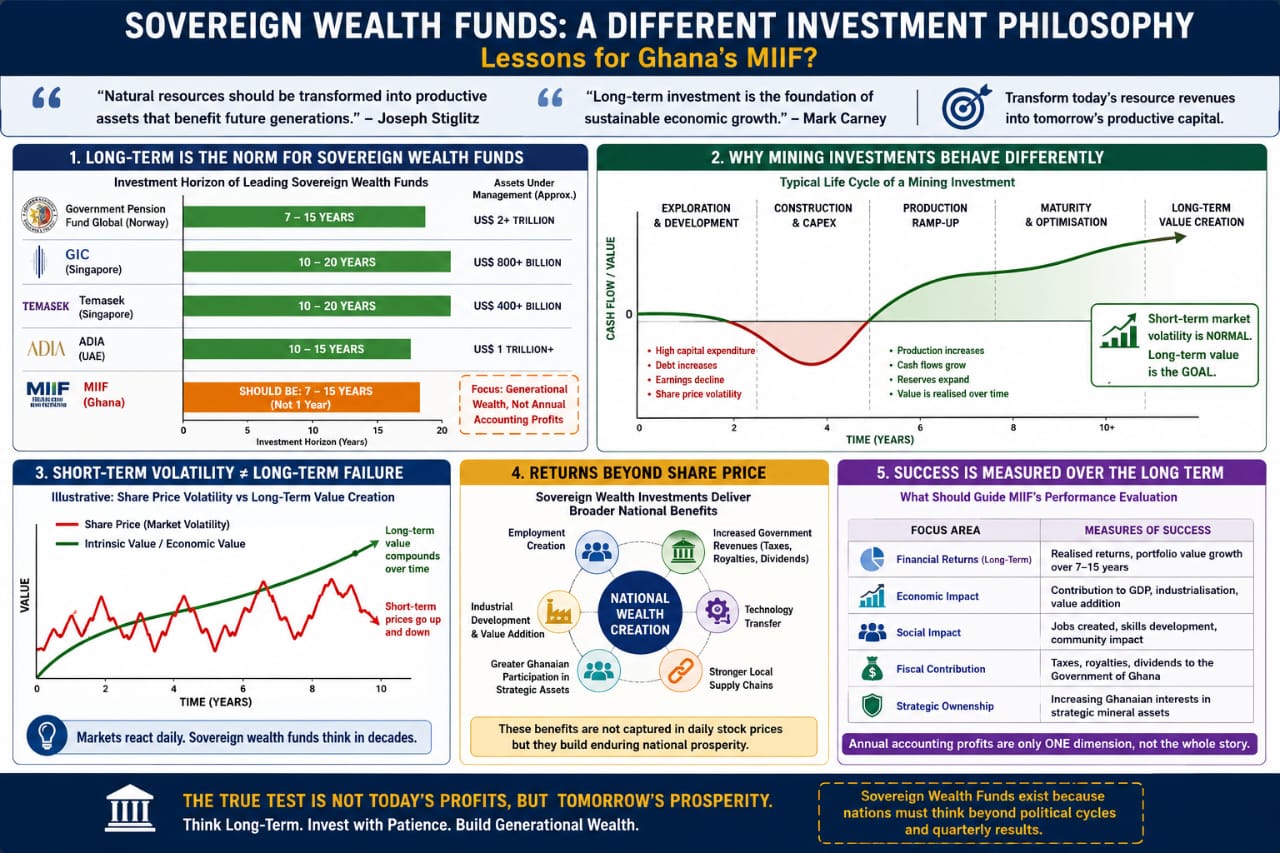
The world’s most successful sovereign wealth funds consistently adopt long investment horizons of between 7 to 15 years.
This is a cardinal principle which seem to have been lost on Ghana’s minerals sovereign wealth fund (MIIF). It is noteworthy to note that MIIF’s earlier position of investing in long term diversified growth assets essential for the long-term development of the mining sector in Ghana was very much in line with international best practices and in the right direction.
For example, MIIF’s investment in Atlantic Lithium led by its former CEO, Edward Nana Yaw Koranteng covering Atlantic’s global assets and its Ghana Ewoyaa mine made MIIF the third largest shareholder in Atlantic globally and the potential for Ghanaian interests to reach 44% in the flagship Ewoyaa mine following the listing of Atlantic on the Ghana Stock Exchange.
This was a master-stroke playbook among other conditions seen by many as the best approach for long term value on the continent.
MIIF’s investments in industrial salt, covering the Songhor Lagoon under lease to a Ghanaian company, Electrochem has the potential to be a multi-billion industrial salt enclave with the potential to utilise the fourteen thousand uses of salt towards converting the Ada area as a chemical industrial enclave. A condition subsequent by MIIF is for Electrochem to list on the Ghana Stock Exchange which if pursued will bring the necessary transparency and capital to make this project a major national asset.
The diversification of investments by MIIF at the time with the long-term horizon in tune with the long-term development goals of the country supports the actual mandate of MIIF and underpins the right investment philosophy. The recent articles by the current MIIF management that its investments are not yielding returns after a year of investment unfortunately betrays a lack of understanding of the sovereign wealth investment philosophy and the mandate of MIIF.
The Government Pension Fund Global of Norway for example, has accumulated assets exceeding US$2 trillion despite experiencing multiple periods of significant market decline, including the Global Financial Crisis, the COVID-19 pandemic and subsequent equity market corrections. At no stage were these temporary declines regarded as evidence of investment failure.
Singapore’s Temasek Holdings and GIC similarly invest through economic cycles, recognising that strategic investments often require years before delivering their full value.
Former Temasek Chief Executive Ho Ching once remarked that “Long-term investing requires conviction and the ability to look beyond short-term market noise.”
Why Mining Investments Behave Differently
Mining investments are unlike traditional financial assets. Developing a mine requires substantial capital expenditure before significant cash flows emerge. Investors therefore frequently experience periods where, capital expenditure increases; debt rises; earnings temporarily decline and share prices become volatile. These developments often reflect investment rather than deterioration.
MIIF’s investment in Asante Gold Corporation (Bibiani and Chirano mines)
MIIF’s investment in Asante Gold Corporation of Canada in the light of the above should be analysed through a sovereign wealth lens rather than a purely speculative market perspective. Recent reference to the volatility of Asante’s shares by some commentators ostensibly from MIIF as a grave issue is another betrayal of a lack of understanding of sovereign wealth funds and MIIF’s mandate.
MIIF’s investment in Asante from 2022 supported the following results which has over the years been well articulated;
the successful revival of the Bibiani Mine after more than eleven years of inactivity;
the acquisition and consolidation of the Chirano Mine into a Ghana-focused mining company;
preservation and creation of employment;
increased opportunities for Ghanaian suppliers and contractors;
future royalty, tax and dividend potential;
greater Ghanaian participation in strategic mineral assets.
These outcomes represent real economic value irrespective of short-term share price fluctuations. Indeed, mining companies commonly experience periods of depressed market valuation while simultaneously increasing reserves, expanding processing capacity and investing for higher future production.
Asante continues to pursue operational improvements, production growth and reserve expansion that have the potential to strengthen long-term shareholder value. Such investments are characteristic of companies transitioning from acquisition and consolidation towards operational optimisation. With estimates of over 700,000 ounces in reserves, Asante may well be a long-term jewel in MIIF’s investment portfolio.
Why Share Price Alone Is an Inadequate Measure
Critics frequently point to declines in market value as evidence of poor investment decisions which seem to be the unfortunate rallying argument of the current MIIF management after just one year in administering the Fund. Unfortunately this argument suffers from three important weaknesses.
First, equity markets frequently misprice companies during periods of uncertainty.
Second, sovereign wealth funds typically invest with investment horizons measured in years rather than months.
Third, national economic returns extend beyond capital appreciation.
For sovereign wealth funds, returns include employment creation; increased government revenues; technology transfer; domestic industrial development; enhanced national ownership of strategic assets; stronger local supply chains.
These benefits cannot be captured solely through daily stock prices.
Warren Buffett famously observed:
“Someone is sitting in the shade today because someone planted a tree a long time ago.” This is what underpins the investment philosophy of sovereign wealth funds.
This philosophy perfectly encapsulates the philosophy of sovereign wealth investing and as a sovereign wealth fund, this must be the direction of MIIF with success measured through long-term portfolio value, realised investment returns, contribution to GDP., employment creation, generation f taxes and royalties, increasing Ghanaian interests and economic diversification. The annual accounting profits represent only one dimension of performance.
The Cost of Short-Termism
History repeatedly demonstrates that abandoning long-term investment strategies because of temporary market volatility and unnecessary politicisation destroys value. Governments that prioritise immediate political optics over long-term investment often sacrifice future prosperity. Successful sovereign wealth funds maintain continuity across political administrations, recognising that national development requires patience, discipline and institutional stability.
As legendary investor Peter Lynch remarked, “The real key to making money in stocks is not to get scared out of them.” The same principle applies to sovereign wealth funds including MIIF.
Policy Implications for Ghana
As Ghana seeks to maximise value from its mineral resources, the strategic importance of MIIF extends beyond annual profitability. Its mandate which appeared to be the case until recently should remain focused on, acquiring strategic mineral interests, supporting value addition, catalysing private investment, strengthening domestic participation and generating sustainable long-term returns.
Investments should undoubtedly be subjected to rigorous governance, transparency and performance evaluation. However, those evaluations should reflect the long-term nature of sovereign wealth investing rather than short-term fluctuations in market prices.
Conclusion
Sovereign wealth funds exist because nations must think beyond electoral cycles and quarterly financial results. The true test of an investment is not whether its market price temporarily rises or falls. Rather, it is whether the investment creates enduring national wealth.
The debate surrounding MIIF’s investments under the previous administration in Electrochem, Atlantic Lithium and in Asante Gold for example presents a broader policy lesson. Sovereign wealth investing requires patience, continuity and disciplined governance. Temporary share-price volatility should inform analysis, but it should never become the sole determinant of investment success as is being promulgated by some.
Ultimately, the objective of a sovereign wealth fund is not simply to generate today’s profits. It is to build tomorrow’s prosperity.
Written by Cobby Brown


