


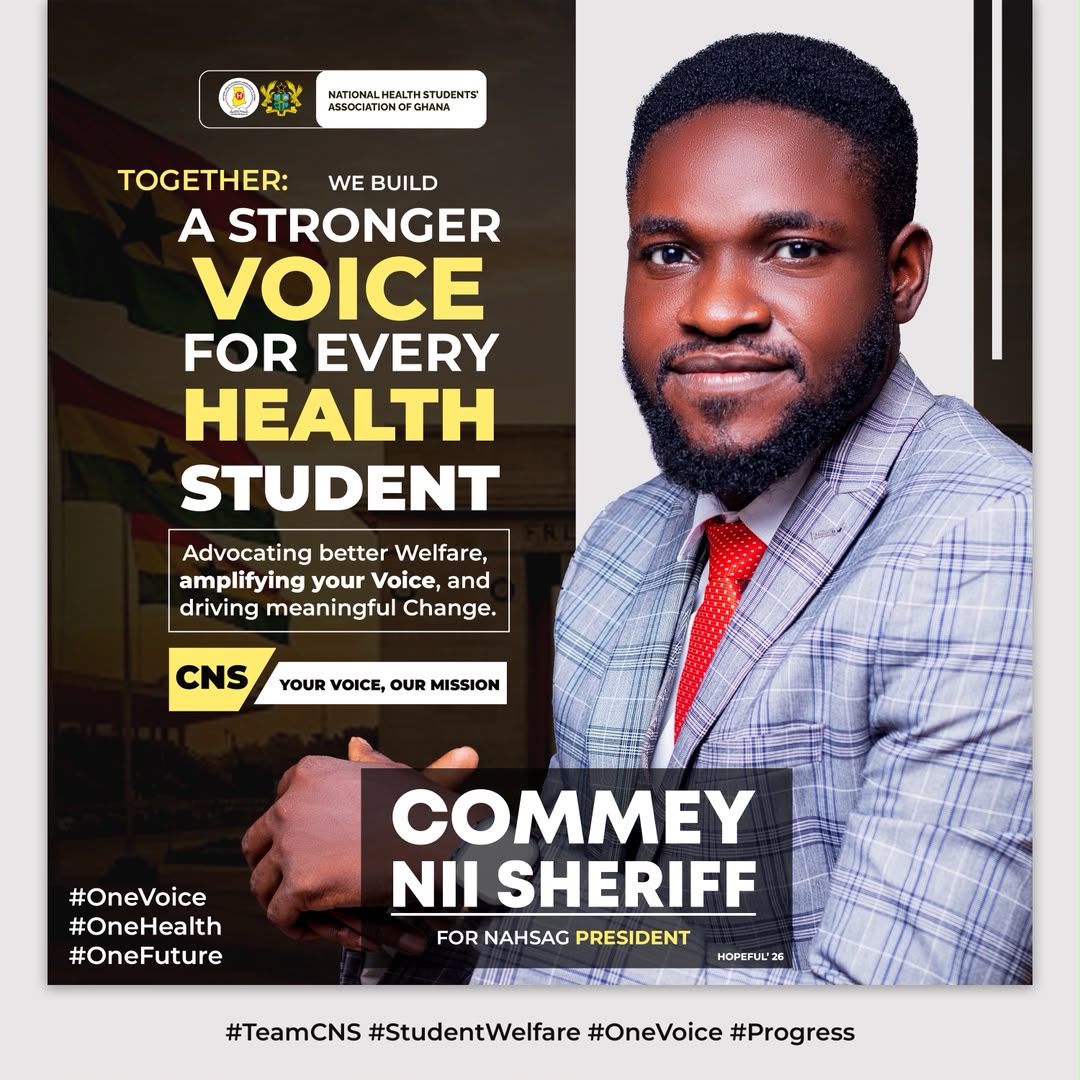
Sheriff Nii Commey: Championing One Voice, One Health, One Future for NAHSAG
Sheriff Nii Commey stands as a dedicated healthcare professional, public health practitioner, medical student, law student and seasoned student leader whose path has been guided by a clear conviction: leadership must deliver tangible difference in the lives of those it serves. His bid for the presidency of the National Health Students’ Association of Ghana (NAHSAG) is no abrupt ambition. It grows from years of active involvement in student leadership, healthcare advocacy, public health work, governance and representation.
- For Commey, the CNS Agenda — One Voice. One Health. One Future. — centres on uniting health students around shared purpose, amplifying NAHSAG’s collective voice and creating practical opportunities that improve everyday student life. He recognises the progress the Association has already made and insists the next administration’s duty is not to discard past gains but to safeguard them, close remaining gaps and carry NAHSAG into its next chapter of growth.

Commey’s multidisciplinary academic journey gives him an unusually broad grasp of Ghana’s health education landscape. He holds a Bachelor of Science in Physician Assistantship from the College of Health and Well-Being, Kintampo, and practises as a registered Physician Assistant with the Medical and Dental Council of Ghana. Expanding beyond clinical work, he earned a Master of Public Health from the Catholic University, deepening his insight into health systems, prevention and community interventions.
He is currently a Level 500 medical student at the University for Development Studies (UDS) while completing his final year of law studies at the University for Business and Integrated Development Studies (UBIDS). He also holds a Certificate in Labour Law from Presbyterian University. This blend of clinical training, public health knowledge and legal education equips him to appreciate the classroom realities, clinical environments, health-system pressures and policy frameworks that shape the lives of health students. For Commey these credentials are not ornamental titles; they are instruments of service.
His leadership record spans institutions and organisations over several years. At UDS he has served as a General Assembly Member of the UDS Medical Students’ Association, gaining experience in deliberation, representation and student governance. Earlier he was Chief Justice of the Physician Assistant Students’ Association of Ghana (PASAG-National) from 2020 to 2021, a role that immersed him in national-level student governance and the demands of institutional integrity. He also served as First Deputy Minister for Sanitation and Water Resources of the United Nations Youth Association-Ghana (UNYA-Ghana) between 2020 and 2021, sharpening skills in youth leadership, public-health advocacy and policy engagement.
Commey’s connection to NAHSAG itself predates the current campaign. From 2019 to 2020 he sat on the Association’s International Affairs Committee, learning its internal workings from the inside. At the College of Health and Well-Being, Kintampo, he held successive student-representative positions: SRC NAHSAG and NUGS Representative, SRC Member of Parliament, and Chairman of the SRC Health and Sanitation Committee (all 2019–2020). These roles placed him in direct contact with students’ daily concerns and allowed him to participate in practical solutions. That accumulated experience at institutional and national levels is precisely what he now seeks to apply at the helm of NAHSAG.
His motivation springs from close observation of the sacrifices health students make. Tuition, accommodation, textbooks, clinical requirements, transport and other academic costs create heavy financial pressure. Students also confront difficulties with clinical placements, welfare support, access to opportunities and effective communication of their concerns to relevant authorities. Commey believes NAHSAG must keep evolving in response to these realities. The central question, he argues, is not merely “What can NAHSAG do?” but “How can NAHSAG become more useful to the ordinary health student?” That question anchors the CNS Agenda.
The agenda rests on a simple premise: health students may study at different institutions, pursue varied programmes and come from different regions, yet they share a common future. “One Voice” calls for stronger representation and advocacy. “One Health” emphasises unity across the spectrum of health professions. “One Future” focuses on creating opportunities for the next generation of Ghanaian health professionals. Four practical priorities guide the work.
First, student welfare comes first. Commey plans to strengthen channels through which students can raise concerns, seek support and receive timely help. A flagship proposal is the establishment of a NAHSAG Student Support Desk — a structured point of contact for welfare, academic, financial and other challenges. Students should know exactly where to turn when they need assistance. NAHSAG must remain accessible throughout the academic year, not only during elections or high-profile national issues.
Second, scholarships and opportunities will receive sustained attention. Drawing on his own experience of helping secure limited scholarship support for students at no cost to them, Commey aims to expand access systematically. Rather than depending on occasional openings, the administration will cultivate stronger partnerships with government agencies, private organisations, development partners, NGOs, international bodies, alumni and other stakeholders. The goal is a system in which no student is left behind simply for lack of information or inability to meet educational costs. Opportunity must not hinge on personal connections.
Third, clinical placement and stronger advocacy form a core pillar. Clinical training lies at the heart of health education. Commey intends to intensify NAHSAG’s engagement with relevant institutions and stakeholders to secure better placement opportunities and improved clinical learning environments. Structured institutional dialogue will allow challenges to be identified early and addressed through proactive advocacy rather than only after they escalate into national controversies. Good leadership, he maintains, anticipates problems and works toward solutions.
Fourth, national leadership must stay connected to the grassroots. The CNS Agenda proposes a modernised feedback and communication channel linking national executives with zonal presidents so that concerns from every zone reach the centre efficiently. A student in any part of the country should feel the presence of the national association. Existing community-outreach initiatives will be consolidated and expanded, ensuring health students continue to make an impact beyond campus walls.
Commey is explicit that his campaign is not a rejection of previous administrations. Every leadership team contributes to NAHSAG’s development; the next team’s responsibility is to build upon what has already been achieved. The CNS Agenda therefore represents continuity with improvement — preserving what works, refining what falls short and introducing new approaches where needed. He describes this simply as taking NAHSAG into its next phase.
What sets Commey apart is the unusual combination of experiences he brings: he has been a health student and a student representative; he has served at both institutional and national levels; he has worked inside NAHSAG; he practises as a Physician Assistant; he has studied public health; he is training as a medical doctor; he is completing a legal education; and, crucially, he remains a student who understands the everyday pressures faced by his peers. He does not claim to possess every answer. Instead he seeks to build a leadership that listens, engages and collaborates with students to find solutions together.
At the heart of his candidature lies a straightforward promise: NAHSAG must work for the student. The CNS Agenda aims to create an association with a stronger collective voice, wider access to opportunities, more reliable welfare support and leadership that stays connected to its members. The strength of NAHSAG, Commey insists, does not reside solely in the national executives; it resides in every health student who believes their voice matters.
Sheriff Nii Commey therefore enters the contest with a clear message of unity, service and progress: One Voice. One Health. One Future. The CNS Agenda is about building on existing gains, strengthening the Association’s voice, creating real opportunities and guiding NAHSAG into its next phase of relevance and impact.


